Lines Drawn by Empire: Displacement, Belonging, and Borders in Reparatory Justice Perspective
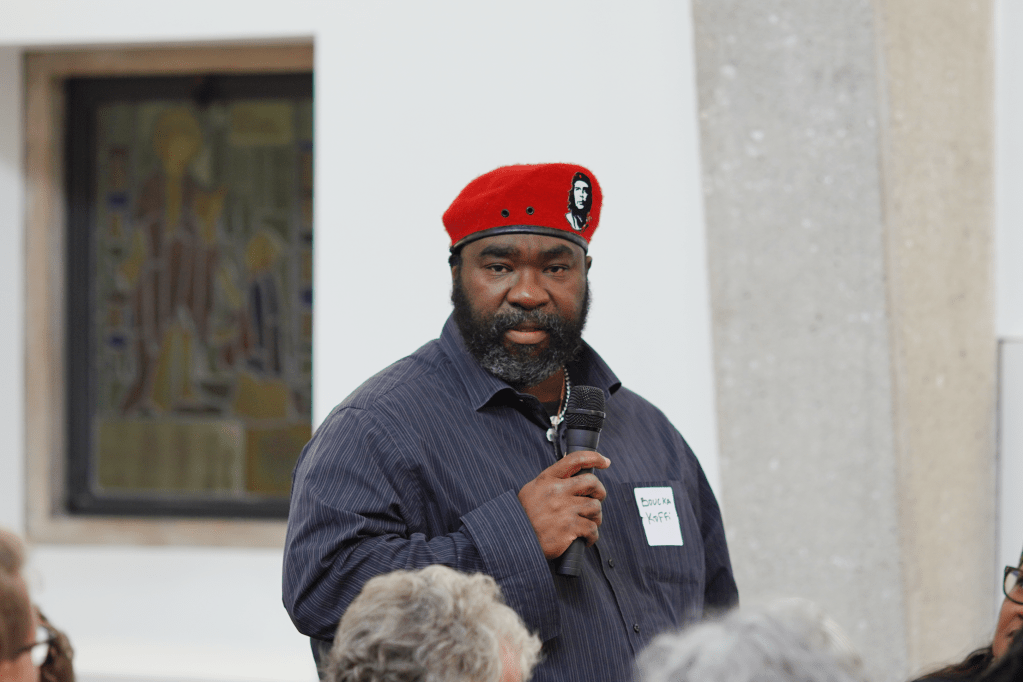
According to your map, I was born on the West African Coast, in a place called Ivory Coast.
But the map is not neutral.
The name itself, Côte d’Ivoire, speaks not of geography but of extraction, of bone and tusk ripped from the land and traded by empire, for empire.
I was born inside a story that my people did not write. A story that began with the commodification of our bodies, of our land. I must begin there: not with identity, not with geography, but with occupation. Because every border, every passport, every open prison, is a relic of empire’s arrogance.
It is an honour to be here today.But let me be clear: what we bring is not a polite contribution to an academic conversation.
Academia, unfortunately, is not neutral.
This is not a diversity box ticking exercise.
We bring a demand.
Conversations about displacement, belonging, borders and bordering are too often held in rooms where those most impacted by forced displacement are excluded.
I am speaking about the source.
The Indigenous communities at the frontline of the globalised geography of violence. Communities carved apart by the ink of 1884-85.
The colonial map was an incision.
And those lines still bleed today.
The borders drawn then created not nations, but extraction zones, pipelines for cheap labour and stolen resources.
After the fall of the Berlin Wall, the powers that once divided our lands returned with a new gospel: democracy.
Neoliberalism as discipline.The ballot box replaced the whip, but the hand behind it remained the same.
So today, when they describe Burkina Faso, Mali, Niger, Zimbabwe, as “failed states” or “dictatorships,” remember: it was not we, who failed at so called modernity.
It was modernity that failed us, by design.
I have got news for the British neocolonial government and the Home Secretary.
In Africa, democracy will come from the disciplined and organised struggles of those who refuse to be governed by the remnants of empire. The communities whose daily lives pay the price of this political tragedy. Until those struggles are real and sustained, what you call democracies, elections will remain what they are: ceremonies of consent in a system that fears liberation.
For our communities, the Akan in Côte d’Ivoire and Ghana, the Fulani in Mali and Niger and many more, our ways of being are rooted in mobility, ecological reciprocity, communal autonomy, ancestral knowledge, and collective stewardship of land. These practices expose the post‑colonial state for what it is: a continuation of the colonial spatial order.This logic of refusal does not stop at our coasts.It follows migration routes to fortress Europe.
Migrants are not seeking economic opportunity.
They are confronting a global system that criminalises the mobility central to their cultural identity.
Migration therefore becomes a transnational extension of refusal. A challenge to Europe’s imagined authority over, who may cross, who counts as human, who belongs.
We must refuse to be governed by a logic that makes borders sacred and people disposable.
We must build and defend autonomous worlds where sovereignty is relational, where belonging is communal, where freedom is measured not by citizenship but by the capacity to live unbounded by systems designed to dominate.
Indigenous ways of living and migrant resistance in Europe form a shared decolonial horizon It is a challenge to the Eurocentric order of borders and racial capitalism, and an insistence on the right to exist, to move, to thrive on our own terms.
We reject the narrative that frames migrants and people seeking asylum as passive recipients of charity. Migrant justice is not a silo; it is entangled with climate justice, abolition, and decolonisation.Because the same systems that criminalise migration fuel the vandalism. The environmental destruction, militarisation, and global inequality.
We must also decolonise ourselves, unlearning the fears planted in us. We must confront the internal agents of empire, for we are undermined not only by external imperial forces but by the bourgeois, the educated elite still trapped in coloniality.
These elites inherit the colonial state and reproduce its logic under the banners of technocracy and development. Even oppositions that appear radical can ultimately reinforce colonial infrastructures. As the bureaucrats policing borders, issuing documents, and enforcing European migration regimes, they become the gatekeepers.
Even in universities, empire survives.
The colonial archive is not buried; it lives in methodology, citation, and the hierarchies of who is heard and who is erased. Knowledge has never been neutral. It has been a weapon used to classify, dominate, dehumanise, and justify.
So let us stop pretending academia is a sanctuary.
It is a battleground, a site of rebellion.
Empire taught us to see displacement as a crisis.But forced displacement is not the exception; it is the foundation of empire. It began with ships, chains, plantations.
It continues in the language of “bogus asylum seeker,” “illegal immigrant,” “economic migrant.”
Migrants, and refugees, are not victims of crisis.They are witnesses of history.Their bodies carry the maps of empire.Their survival is resistance.
To decolonise belonging, we must stop asking Who belongs?
And instead ask: Who benefits from exclusion?
We must also remember: Western imperialism dismantled our political, social, and economic systems.
We use the term FreedomSeekers for people whose journeys speak of courage, and defiance against fortress Europe’s hierarchies of humanity. Migration is a form of resistance.
Migrant justice is Pan-Afrikan.
Freedom of movement is the last frontier of decolonisation.
We walk in the shadows of martyrs like Kwame Nkrumah, Patrice Lumumba, Modibo Keita, Thomas Sankara and many more….
Our struggle was never only for nation-state independence; it was for self-determination, for workers, peasants, women.
A classless, raceless, global struggle against intertwined systems of exploitation, surveillance, and dispossession.
That work remains unfinished as long as borders kill.
At the beginning of this speech I said I was born in Côte d’Ivoire. The assumption is that Côte d’Ivoire exists as a coherent state.Yet its foundations were laid for extraction, not liberation. Its recent elections, like those in Cameroon or Tanzania, reveal the contradictions of states built to serve empire. Elections become rituals of legitimacy rather than instruments of emancipation.
Ivory Coast does not exist.
It is a colonial hallucination. A name invented to legitimise violence against Indigenous communities. It is as fabricated as “economic migrant,” “bogus asylum seeker,” or “illegal immigrant.” This is why, at VVIDY, we use the term FreedomSeekers.
Our struggle predates our existence, just as the struggle for liberation predates the “Scramble for Africa.” We speak of restitution, restoration, reparations. Of planet repair. A world where freedom of movement is a right, not a privilege.
Migrant justice is part of a broader decolonial movement to reclaim histories, epistemologies, and futures erased by empire.
If we speak our resistance in the language of empire, if we let our oppressors define the terms of our struggle, we will remain trapped inside their imagination.
Liberation begins in language.To decolonise is to rename, to reimagine, to rebuild meaning from the ground up, from the communities’ empire tried to erase.
So today, as a Decolonization matter of Pan-Afrikan Reparatory Justice for Planet Repairs, I reclaim my birthplace not as Ivory Coast, but as the uncolonized dream of those who refused subjugation.
I reclaim my birthplace as part of the homeland of our indigenous Akan nation, still bleeding from the genocidal division by the colonial borders of present-day of French-colonised Cote d’Ivoire and British-colonised Ghana; an indigenous Akan nation that shall win its real Freedom only when the true Reparatory Justice victory of our Pan-Afrikan Revolution for Planet Repairs restores it as one of the building blocks of our MAATUBUNTUMAN Pan-Afrikan Union of Communities of Resistance!
I was born in Africa.
We are not data. We are not policy subjects.
We are the descendants of abolitionists, of community builders, of border-breakers.
We are, and will remain FreedomSeekers.
LSE Event 20/11/2025: Lines drawn by empire: displacement, belonging, and borders
 VVIDY
VVIDY 